




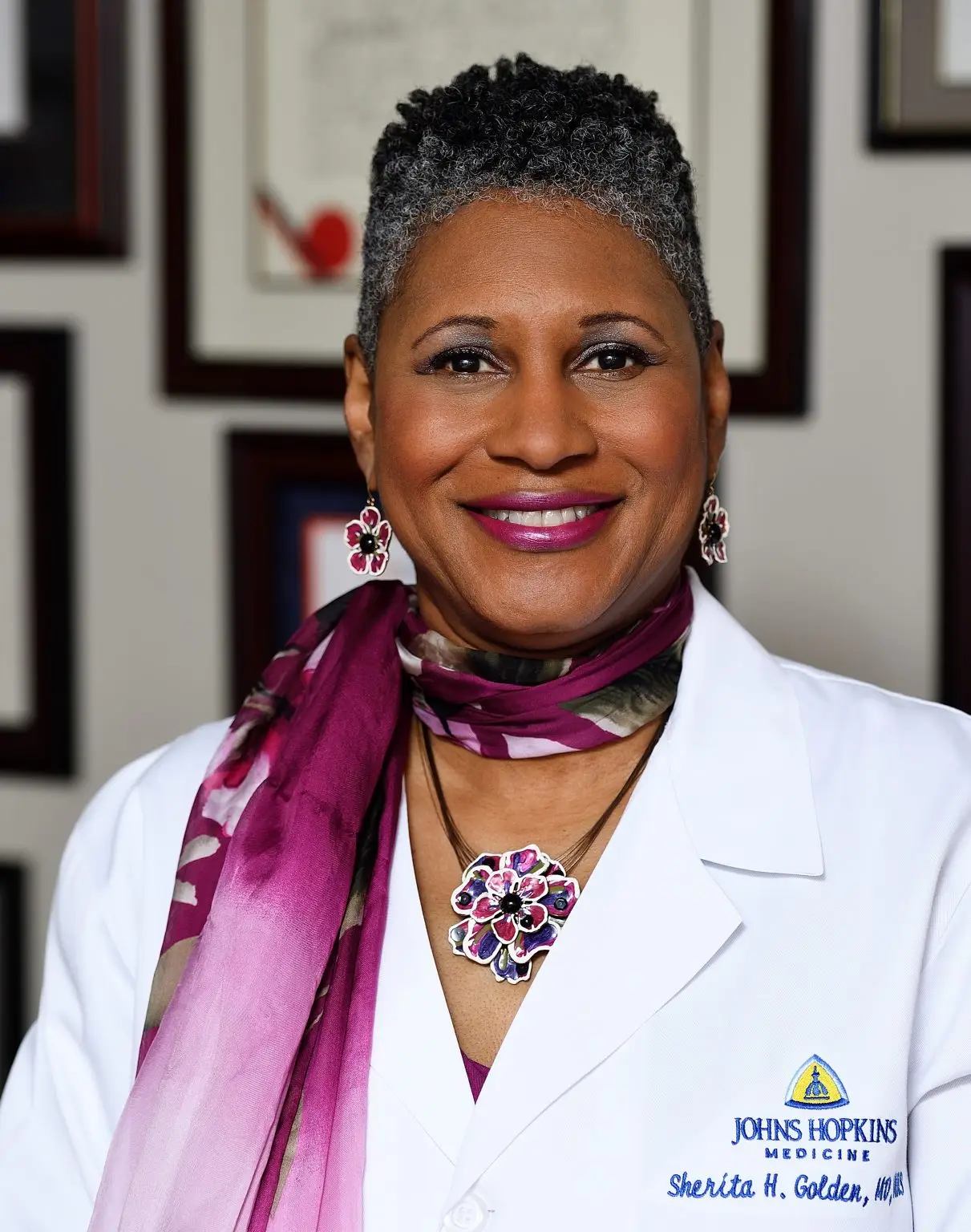
On The Scholars’ Table, Johns Hopkins endocrinologist Sherita Hill Golden remembers the call home that helped her choose a specialty. The two people on the other end are in their nineties now, and she helps care for them both.
Sherita Hill Golden still remembers the little boy’s long eyelashes. He lay on a warmer after open-heart surgery, a bandage over his breastbone, a pacifier in his mouth. Golden was a medical student on her pediatric cardiology rotation. All she could think about was how much he would hurt when he woke up.
She had wanted to be a pediatrician since she was ten. She pictured a practice back home in Maryland, much like her family doctor’s, with well-baby visits and camp physicals. She had even taken internal medicine first so she would know how to present a case by the time she got to pediatrics.
She called her parents in tears. They had watched her become the first in the family to go to college. “Didn’t you just do something called internal medicine that you liked?” Golden remembers them asking.
Ten patients in half a day
Her first patient on the diabetes ward had been a 35-year-old man already living with severe complications of type 1 diabetes. Golden liked helping people work out how to manage the disease. She also had a habit, a faculty member observed, of asking questions nobody could answer yet. He introduced her to clinical research. When she chose Johns Hopkins for residency, part of the appeal was that the school of public health stood just across the street from the hospital.
In half a day of clinic, Golden could see ten people. She kept thinking about the thousands who needed the same care. She went on to lead the inpatient glucose management program at Johns Hopkins Hospital for fifteen years. When her team rewrote the orders clinicians used to treat diabetes, the changes reached patients she would never meet.
“What we do in that clinical encounter is only a smidgen of what impacts the lives of people living with diabetes.”
One example Golden gives is the electricity bill. A patient who can’t keep the power on has no reliable place to refrigerate insulin. Before drawing conclusions from a blood sugar reading, she wants to know what happened at home.
An invitation she can turn down
In 2024, a definition of privilege from a Johns Hopkins Medicine newsletter circulated online. Golden, then the institution’s chief diversity officer, says abusive emails came in from across the country. A colleague urged her to stay. On the podcast, Golden reads aloud what she wrote about her decision to leave at 55.
“I had parents to usher toward heaven in their twilight years and grandchildren yet to cradle.”
These days Golden turns down invitations to apply to be a department chair or a dean. Her parents are both in their nineties. Getting care for them has been hard even for a daughter who knows the hospital from the inside. She’s learning to be a patient advocate, with other families in mind, especially the ones who have nobody in medicine to call.
“They are my focus,” Golden says of her parents, “just like I was their focus for all those years I was going through medicine.”
Adapted from Banda Khalifa’s conversation with Sherita Hill Golden on The Scholars’ Table.