





On November 18, South Africa’s medicines regulator issued a notice about submitting older reports of suspected, non-serious drug reactions through an industry reporting system. It reads like administrative housekeeping. For anyone building an AI system to watch for drug risks, it raises a question worth asking before the first alert goes out. Does the software count from the day a patient felt unwell or the day the report arrived?
Suppose several months of reports reach a safety office on the same Monday. A chart organized by receipt date could show a sharp rise. Plot those same reports by the date symptoms began and the apparent cluster might disappear. Both dates belong in the record. One helps a regulator understand what patients experienced. The other tells a safety manager how long it took that experience to reach someone who could investigate.
African health systems already produce evidence that can change how the world understands a medicine. Botswana’s investigation of an HIV treatment in pregnancy is one example. AI could help safety teams find the cases that warrant a closer look. Whether it improves a decision depends on what happens between the patient’s first symptom and the advice that eventually reaches the clinic.
What changed in Uganda when reporting got easier
In Uganda, a team led by Ronald Kiguba tested a straightforward idea. Health workers at facilities offering dolutegravir-based HIV treatment received training in how to report suspected adverse drug reactions. At facilities assigned to the intervention, staff also learned to use the Med Safety smartphone app. Of 382 facilities randomized, 367 entered the main analysis. The rate of reporting was 73% higher in the app group, with a 95% confidence interval ranging from 26% to 137% higher. The investigators measured whether a suspected reaction reached the reporting system. The randomized trial appeared in The Lancet Global Health.
Imagine a national safety team comparing two districts after such a rollout. The district with more reports might have a pharmacist who trained her colleagues and follows up every Friday. The quieter district might have the same burden of illness and fewer opportunities to report it. If software uses last year’s reporting volume to decide which clinics deserve attention this year, it could keep sending reviewers to the places they already hear from. The Ugandan trial also gives a procurement team a fair question to put to an AI vendor. How much more could the same budget accomplish than a reporting tool and time for staff to use it?
A safety team reading spontaneous reports rarely knows how many people took the medicine and how many experienced symptoms that nobody reported. Patients and clinicians may also report the same episode separately. A count can justify a phone call. Estimating a patient’s chance of harm requires a different kind of evidence. The FDA spells out these limits for its own public reporting database.
Four cases in Botswana, and the years it took to interpret them
In 2018, Botswana’s Tsepamo investigators reported neural tube defects in four of 426 infants whose mothers had been taking dolutegravir at conception, about 0.94%. They had observed 14 among 11,300 infants whose mothers were taking other HIV treatment at conception, about 0.12%. These are serious birth defects involving the developing brain or spine. For a woman doing well on HIV treatment and considering pregnancy, even a preliminary finding could make the next clinic conversation difficult. The investigators published their early observations in a letter. By September, both counts appeared in the 2018 US prescribing information for Juluca, a medicine containing dolutegravir.
What made a better answer possible was the decision to keep looking. Midwives examined babies at delivery, including stillbirths. Investigators recorded maternal treatment and arranged specialist review of suspected abnormalities. In their 2026 analysis of births through August 2022, the team reported 12 neural tube defects among 11,110 infants exposed to dolutegravir at conception, about 0.11%. The corresponding estimate for other HIV regimens at conception was 0.10%. The later finding gave clinicians firmer ground for discussing the size of the risk, while leaving room for the uncertainty that comes with a rare outcome.
The four original cases still belonged in the record. What changed was the number of pregnancies against which clinicians could interpret them. A manufacturer preparing a safety response should fund that follow-up from the outset. Someone also needs responsibility for going back to the clinics that heard the first warning. The physician counseling a patient several years later deserves to hear that the estimate changed, and why.
“The four original cases still belonged in the record. What changed was the number of pregnancies against which clinicians could interpret them.”
Give the model a job a safety officer can check
I would start with one task. Give a safety reviewer the original account alongside the drug name, timing and symptoms that a language model proposes to extract. For each entry, show the words the model used. If a nurse wrote that a patient denied a rash, the reviewer should be able to see the word “denied.” If nobody recorded when the rash began, leave the date open and let the reviewer decide whether to call. A system designed this way makes a specific promise. Someone qualified to read the case can check it.
There is a useful precedent for sorting the review queue. Researchers at the Uppsala Monitoring Centre tested a statistical model called vigiRank, which weighed features including how complete and recent the reports were. Six of 194 initial assessments led reviewers to identify a safety signal, or possible risk worth investigating. An earlier method had yielded 19 signals from 1,592 assessments. That historical comparison suggests reviewers can get more useful leads from the time they spend reading. It leaves open how the model would perform in a particular national program.
Handing a language model the harder job of judging whether a drug caused an event is another proposition. In a 2026 study of 55 selected case reports from the US FDA system, researchers compared model judgments with expert classifications across 337 drug assessments. One configuration achieved 80.4% accuracy overall. For cases experts classified as “possible,” its F1 score, which balances the ability to find such cases with how often that prediction is right, was just 0.293 on a scale of zero to one. A buyer shown only the headline accuracy would miss a weakness precisely where a clinician has reason to be uncertain.
Before paying for national use, I would run the model quietly alongside the existing team. Let reviewers at sites outside the training sample judge cases in the languages and abbreviations they actually encounter. Give a second clinician a random sample from the bottom of the queue. That is where a serious case the model overlooked would otherwise stay invisible. Track how many serious cases it missed and how long a patient waited for follow-up. Keep urgent reports on their usual clinical route throughout the test. This is a practical way to apply the FDA and EMA’s guidance on evaluating AI for its intended use.
I would also write a stopping rule into the contract. Suppose the model saves reviewers an hour each morning at a referral hospital but starts downgrading serious cases from a district clinic after a software update. The local safety lead needs the authority to switch it off there, the records to work out what went wrong and a staffed review queue to fall back on. A promise to fix it in the next version is a poor answer to the nurse who filed the report.
What a drugmaker should pay to find out
Suppose a safety team sees reports of kidney injury after a newly introduced medicine. This is a hypothetical example. The team should review serious cases promptly. For the broader question patients will ask, it needs to know how often injury happens among comparable people taking each available treatment. Dispensing records can identify who started each medicine. Laboratory records can help establish whether an injury occurred. The research team still has to decide whether it can follow those people long enough to give a credible answer. That work turns routine health data into what regulators call real-world evidence.
I would compare people newly starting treatments used for the same illness, begin follow-up at the first dispensing, and agree on a definition of kidney injury before looking at the results. If clinicians preferentially give one medicine to patients with poor kidney function, their starting risk differs. If one clinic tests more often, it has more opportunities to detect injury. A patient who transfers before the next blood test has an unknown outcome. Counting that patient as well would buy false reassurance. These are the design questions addressed by the ICH M14 guidance on observational drug-safety studies.
The result I would want for a prescribing discussion is an estimate of how many additional patients per thousand might experience injury over a stated period, with a range showing the uncertainty. Getting there may require paying a pharmacist to reconcile treatment histories or a clinician to review charts at a referral hospital. If the available records cannot support that estimate, fund the missing follow-up before buying a more elaborate model.
“If the available records cannot support that estimate, fund the missing follow-up before buying a more elaborate model.”
Who gets the answer back to the clinic?
In October, Africa CDC reported that member states had validated a continental health data governance framework. For a hospital and a manufacturer negotiating a safety study, the practical decisions are still local. Who can authorize a new question? Can the hospital’s investigator inspect the cases and publish a finding the sponsor would prefer to delay? Those terms belong in the agreement, alongside a budget for the staff doing the follow-up. Where records must stay at the hospital, partners can run the agreed analysis there. The hospital can then review which results may leave, including whether a table describing a single rare event could identify the patient in a small community.
Return to the two dates in the South African example. A safety director considering an AI purchase could ask a vendor to bring one flagged case to the next review and trace what happened. When did the patient first report a symptom? Who noticed it, who called the clinic, and what could the prescriber tell the patient afterward? I would fund a system that helps a pharmacist make that call sooner and gives the clinician a better answer when the patient comes back.
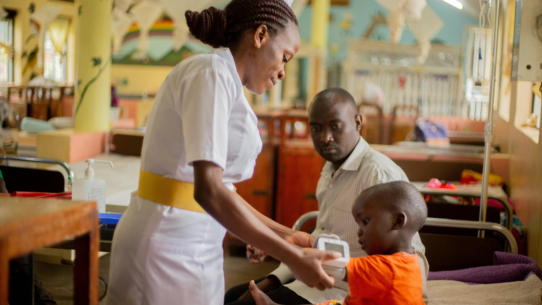
“Using Data to Track Health in Kenya” by David Snyder/CDC Foundation, via CDC Global. Cropped for this article under CC BY 2.0.