



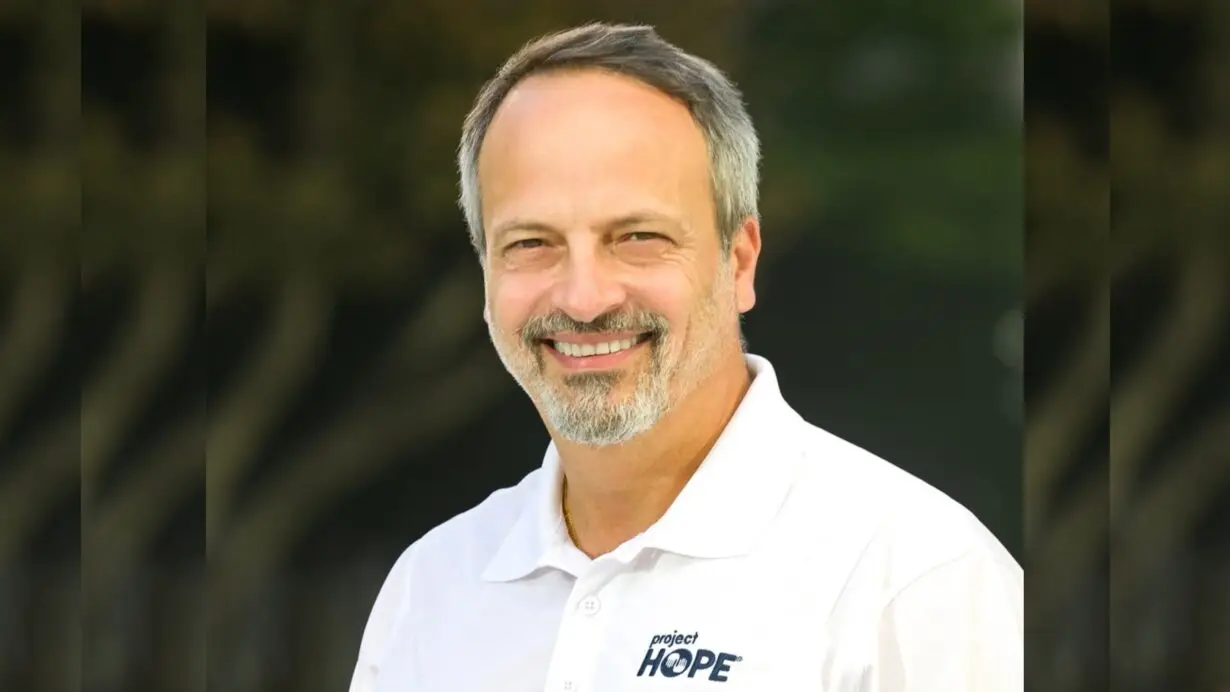
Project HOPE CEO Rabih Torbay has spent more than 25 years responding to humanitarian emergencies. In a conversation with Dr Banda Khalifa, he reflects on the moment that changed his career, the human cost of aid cuts, and what the next generation needs from those in power.
When Rabih Torbay visited a hospital in Kyiv in 2022, he met a woman in her seventies who had been shot. The bullet had passed through her arm and chest. He had come to offer support. Instead, she embraced him and thanked him for being there. When she noticed how emotional he had become, she began comforting him.
“Instead of me comforting her, she was comforting me,” he recalls.
It is one of the encounters that has stayed with Torbay through decades of work in conflict zones. The injury, the hospital, the country under attack: none of it diminished the woman’s concern for the stranger at her bedside. For Torbay, the encounter held together two realities he has come to know well. Human beings can inflict extraordinary suffering, and they can respond to it with extraordinary generosity.
In a wide-ranging conversation on The Scholars’ Table with Dr Banda, the chief executive officer of Project HOPE spoke about the decisions that brought him into humanitarian work, the people who sustain it, and the growing distance between the world’s needs and its willingness to respond.
“People are tired of being called resilient without any assistance.”
The engineer who changed course
Torbay did not begin his career in public health. He grew up in Lebanon during its civil war, trained as a civil engineer, and moved to Sierra Leone in 1992. He established a career in construction as another conflict engulfed his new home.
The turning point came in 1999, after rebels attacked Freetown. He volunteered with a humanitarian organization, initially for two weeks. A cholera outbreak on an island off the coast then drew him into an emergency response. He sold his business and property and used his own money to support the work.
He remembers seeing what even a modest intervention could accomplish when people had access to treatment, supplies, and practical support. The experience altered his understanding of what he wanted his work to mean.
“I realized that this is where my passion is,” he says. “This is what I’d like to do.”
That decision led to a career spanning Afghanistan, Iraq, Darfur, Ukraine, and other places affected by conflict and disaster. Torbay joined Project HOPE in 2017 and became its president and CEO in 2019. He now leads the organization as its chief executive officer.
His account is not a claim that goodwill alone can solve a health emergency. The lesson he draws from Sierra Leone is more concrete: resources, deployed quickly and alongside people who understand their communities, can change what happens next.
Why the health worker comes first
Project HOPE began in 1958 with an unusually practical idea: a hospital ship that would deliver care while training local health professionals. The ship was retired in 1974, but the emphasis on health workers endured. The organization now operates in more than 30 countries, responding to emergencies and supporting longer-term health services.
For Torbay, a strong health system begins with people who can make it function. Equipment is of little use without someone trained to operate it. Medicines cannot deliver their intended benefit without the expertise and systems needed to prescribe and distribute them. Even a capable clinician is constrained when essential supplies are missing.
That is why Project HOPE places such emphasis on training health workers, equipping them, and working with local health authorities rather than treating outside organizations as the owners of the response.
“We don’t have answers. They have the answers,” Torbay says of local communities.
It is a challenge to a familiar habit in international assistance: arriving with a predetermined solution and expecting communities to accommodate it. Torbay argues for a different relationship, one in which international organizations contribute capabilities and resources while local professionals retain a central role in defining what is needed.
“Nobody knows the solution better than the people on the ground.”
When a funding decision reaches the clinic
The consequences of getting that relationship right become clearest when support disappears.
In 2025, cuts to United States foreign assistance forced Project HOPE to close USAID-funded programs in Ethiopia, Gaza, Haiti, Namibia, and Zambia. The affected work included HIV services, maternal health care, and emergency assistance. For a leader accustomed to mobilizing help, Torbay describes the experience of having to withdraw it as especially painful.
He remembers the conversations with colleagues whose jobs could no longer be supported. More difficult still was the thought of patients being told that treatment or a clinical visit might no longer be available.
“Imagine going to a community in need and telling them, ‘You’re on your own,’ basically,” he says.
These are not abstract budget adjustments. A reduction in financing can mean a clinic with fewer staff, an interrupted course of care, or a family forced to find another place to seek treatment. Torbay says Project HOPE sought new backing from private and other government donors to preserve essential services where it could, including in Gaza.
The pressure is intensified by the growing danger faced by health workers themselves. In August 2026, the World Health Organization reported more than 10,400 attacks on health care across 29 countries and territories since 2018. The human cost extends beyond those directly injured or killed: every disrupted service leaves more people without care when they need it.
Torbay has seen that strain at close range. In Ukraine, he visited Bucha after Russian forces withdrew and spoke about the psychological burden borne by a doctor who had been forced to collect and bury civilians killed during the occupation. The experience left him thinking not only about the visible destruction but also about the people expected to continue caring for others while carrying trauma of their own.
What it takes to do this work
To young people considering humanitarian careers, Torbay offers an unusually broad invitation. A sector that relies on doctors, nurses, and public health professionals also needs engineers, logisticians, finance specialists, administrators, communicators, and people who keep essential infrastructure running.
A hospital, he points out, cannot function on clinical expertise alone. Its ability to treat patients also depends on procurement, staffing, financial management, sanitation, and maintenance. These jobs may be less visible, but they are part of the delivery of care.
Asked what distinguishes a promising applicant, Torbay moves beyond the conventional emphasis on years of experience. He still values professional competence, especially in roles where safety depends on it. But he wants to understand why a candidate is drawn to the work and whether that motivation is matched by a willingness to learn.
“I started looking at potential,” he says.
His practical advice is to write a thoughtful, specific cover letter and speak candidly in interviews, rather than offering the same polished answers as everyone else. He also names emotional intelligence and adaptability as essential capacities. Humanitarian settings rarely follow the plan. People need to recognize when an approach is failing, listen, and change course.
The same realism applies to personal wellbeing. Having witnessed suffering across several wars, Torbay does not pretend that the work leaves those delivering it untouched. He speaks about the strain on health, family life, and psychological wellbeing, and the responsibility leaders have to look after their teams.
“You’re not useful to anybody if you’re burnt out.”
Beyond the language of resilience
Near the end of the conversation, Torbay is asked which word he would remove from humanitarian meetings. His answer is resilience. His objection is not to people’s endurance, but to using that endurance as a reason to withhold help.
His criticism goes to the heart of his leadership philosophy. Praising a community’s capacity to endure is easy. Making sure its clinics have staff, its patients have medicines, and its health workers can do their jobs requires decisions, resources, and sustained responsibility.
And yet, despite the funding cuts, the violence, and the personal cost, Torbay remains convinced that humanitarian work is worth pursuing. In fact, he believes the present moment makes it more necessary. To people discouraged by the sector’s condition, he offers a direct answer.
“This is when the world actually needs you more than ever.”
Asked what he hopes younger listeners will take from the conversation, he turns the responsibility back toward the generation now entering the field. They will be the ones making many of the decisions that shape what comes next. The responsibility of experienced leaders, he suggests, is not merely to tell them to persist.
“Our job, the old ones, is to make sure that you’ve got what you need to really change this world.”
This article is adapted from a conversation between Rabih Torbay and Dr Banda Khalifa on The Scholars’ Table. The interview is part of the series published in Meridian Letters.