
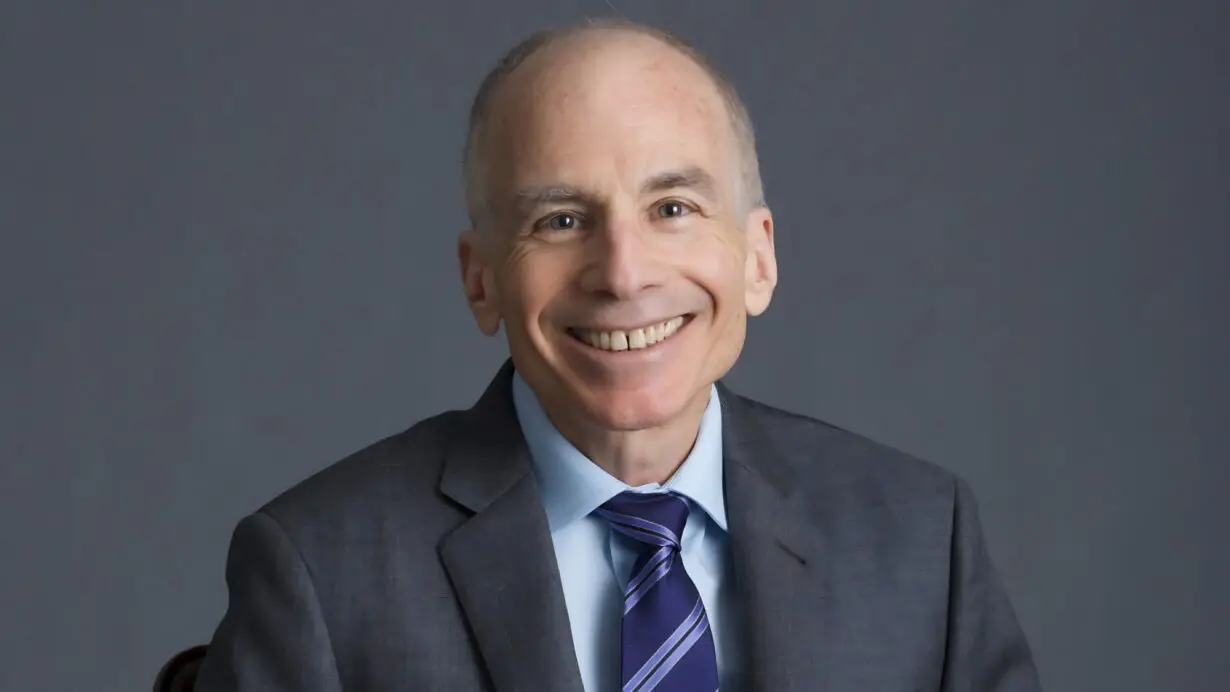
Lawrence Gostin, founding director of the O’Neill Institute for National and Global Health Law at Georgetown, on why no single body is in charge, what the world gets wrong about the WHO, and why the fixes are unglamorous: sustainable financing, equity as fairness, and telling the public the truth.
Ask Lawrence Gostin who governs global health, and he treats it as the easy question. “No one,” he says. “No one governs global health.” It is, in his description, a fragmented and diverse governance system with no world enforcer and no world compliance. The World Health Organization has the constitutional mandate to lead, but not, he argues, the capacity or the trust to do it alone.
Gostin is founding director of the O’Neill Institute for National and Global Health Law and a Distinguished University Professor at Georgetown, Georgetown’s highest academic rank. He directs a WHO collaborating center on global health law and co-chairs a Nature Medicine commission on quality health information. For decades he has worked on the legal foundations of health, the limits of state power, and what countries owe one another in a crisis. His account of the field is affectionate and unsentimental at once.
A system with no one in charge
When the WHO was formed in 1948, he notes, it was effectively the singular global health actor. Today, it operates in a sea of institutions: Gavi, the Global Fund, Unitaid, CEPI, and large philanthropies, including Bloomberg, Gates, and Rockefeller. Even in an emergency, whether COVID-19 or the current Ebola outbreak in the Democratic Republic of the Congo, no single entity is in charge. The WHO’s health emergencies program is active on the ground, Africa CDC plays a large role, and the affected countries carry the response. The result is capable actors without a governor.
What the world gets wrong about the WHO
The most common misunderstanding, he says, is about power the organization does not have.
The WHO can’t require any country or any person to do anything. Literally, they have no power, and their member states don’t give them the power.
From there, he is blunt about a specific political claim. “The Trump administration has been trumpeting for a long, long time that the WHO favored China during COVID-19, and that there was a lab leak and the WHO refused to investigate it,” he says. “Frankly, that’s rubbish.” He says he knows from the inside how hard the WHO pushed China to allow an independent investigation into COVID-19’s origins, and that the agency can only do what its member states permit and fund. They provide it little, he argues, while constantly curtailing its authority. You get what you put in.
A watered-down compromise worth having
On the pandemic agreement adopted at the World Health Assembly, he does not oversell it. “Of course it’s a watered-down compromise,” he says, describing states unwilling to cooperate and each wanting its own view to prevail. He has been involved in the drafting and negotiation, particularly assisting African countries, and he keeps returning to two fundamentals: scientific innovation, and the equitable sharing of its benefits. Both, not one pitted against the other.
He is precise about where things stand. The agreement is not yet in force; it cannot open for signature until the annex on pathogen access and benefit sharing is agreed; that annex missed its deadline at the Assembly, and members extended the negotiation by up to another year. “International law is necessary for global solidarity,” he says, “but it’s not sufficient.” His hope is modest and concrete: bring the agreement into force with a workable annex, pair it with the amended International Health Regulations, and count two net gains.
Asked what reform would help most, he does not reach for anything grand.
They can be much more effective if member states provide sustainable financing and allow the WHO to allocate those funds to the global health priorities, and not to the pet project of the donor.
Equity is fairness, not equality
Equity is the word he is most careful with. It is not equality, he says. You do not treat everyone the same; you treat everyone fairly and justly. In practice, when life-saving medical technologies are being allocated, that means giving lower-income countries and poor people a real chance at access, and allocating by need and by where the benefit will be greatest, even against the political gravity of governments protecting their own first.
He extends the point to what he calls health sovereignty, an idea popular now in sub-Saharan Africa: countries taking responsibility for their own health by building the science, laboratories, and manufacturing to make their own products. “You might even call health sovereignty more health responsibility,” he says. It still needs international cooperation, funding, and technology transfer, companies in Europe and North America sharing trade secrets, but he argues the whole system ends up with less scarcity and more product when more regions can innovate and manufacture. His sharpest example of the opposite instinct is a reported plan to stand up a US quarantine and treatment facility in Kenya for American citizens exposed to Ebola. Offloading that risk abroad while refusing it at home, he says, is “very insulting and wrong.”
Coercion, liberty, and common sense
On civil liberties in an emergency, he resists absolutes. Most of the time, he argues, human rights and public health are synergistic: decriminalizing people in an epidemic, or respecting burial customs, brings the response into the open and makes it work. When they do conflict, he falls back on two questions he credits partly to his father’s common sense. How effective will this coercive power actually be, and will it save lives or is it political theater? And how much is it imposing on the individual? Then he balances the two and reaches for the least restrictive measure that achieves the purpose.
Applied to Covid, that yields a split verdict. Requiring a mask on a crowded aircraft during a pandemic he defends without hesitation: “If the CDC can’t require somebody to wear a mask going on a crowded aircraft during a pandemic, I really don’t know what it can do.” School closures and lockdowns are where he thinks the response overreached and needed far more care. He applies the same logic to borders, pointing to South Africa, which sequenced and reported the Omicron variant quickly, shared it with the world, and was met with travel and trade restrictions. That, he says, is exactly the wrong lesson to teach.
Tell the public the truth
His prescription for trust is not a campaign. It is candor. Public health agencies, the WHO and the US CDC alike, need to say plainly what they know, what they do not, and what they are doing to find out, and to explain that science operates under uncertainty and changes as evidence does. Changing your mind on new evidence, he stresses, is a good thing, not a failure. The harder problem is that the information environment has decayed: a cacophony of social media influencers amplified by artificial intelligence, and, he says, a CDC website people no longer fully trust because they cannot be sure it has not been politically controlled.
He closes on people rather than institutions. What gives him hope, even as an American dismayed by his own country’s choices, is what he sees elsewhere: scientists, humanitarians and doctors rushing into conflicts, advocates fighting for the right to health. His parting advice is almost plain enough to underline. “Take care of your neighbor, take care of your environment, and be a good person. Be decent and be honest. That’s what we need now.”
This feature is adapted from a conversation on The Scholars Table with Dr. Banda Khalifa.