




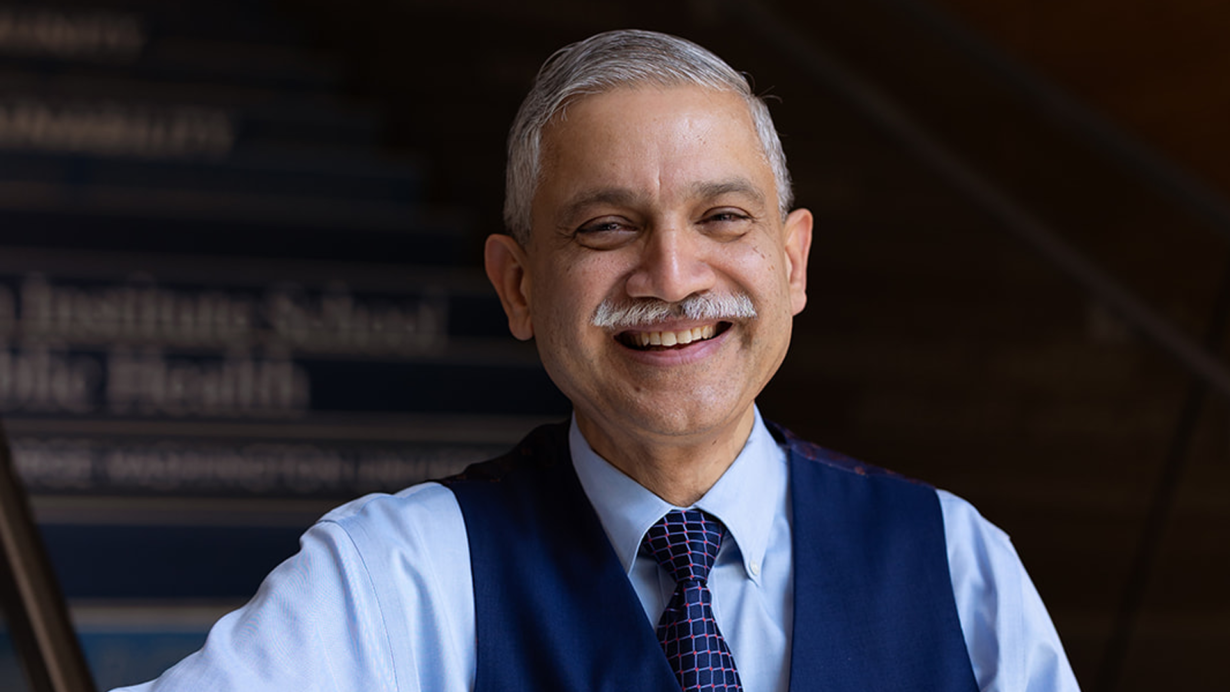
When I asked Dean Adnan Hyder whether a public health degree is still worth it in 2026, he answered as if he knew the question was incomplete.
Worth, he said, depends on the metric. If the metric is income, the answer depends on where a graduate goes. Industry, pharmaceuticals, biotechnology, and the private sector may produce one kind of return. Government, nonprofit work, and academia may produce another. If the metric is impact, the answer changes again. Public health can place a person inside decisions that shape access, systems, drugs, care delivery, health departments, and the lives of communities.
That distinction shaped the entire conversation.
Dean Hyder, now leading Boston University School of Public Health, has spent his career across medicine, health systems, injury and violence prevention, bioethics, and global public health. He trained as a physician in Pakistan, earned graduate degrees at Johns Hopkins, spent two decades on the Hopkins faculty, later served at George Washington University, and then joined Boston University. In his telling, the career was never built around one narrow disease area or a single academic lane. It grew from a wider question: how do institutions, systems, and people create the conditions for health?
The answer he returned to again and again was capacity. Public health needs people who can think clearly, work across sectors, stay grounded in equity, and remain useful to society.
Public health schools have to prove their usefulness
One of the strongest moments in the conversation came when Dean Hyder described the responsibility of schools of public health in the current moment.
He did not treat public health’s challenges as abstract. He spoke directly about threats to public health and science, the strain on public trust, and the need for institutions to explain their value. For Boston University School of Public Health, he said, excellence in research, policy, and service remains necessary. The field now has to go further. Public health schools must show why they matter to society.
That is a demanding standard.
Usefulness means more than producing degrees. It means training students who can leave with skills they can apply. It means contributing to Boston, Massachusetts, the United States, and global communities in ways that stakeholders can recognize. It means treating education as a public function, not a private transaction between a student and a university.
For prospective students, this matters because public health education is expensive, competitive, and often emotionally loaded. Many applicants treat admission as the main question. Hyder’s framing suggests a different one: what will this education prepare you to do, and for whom?
Fit matters more than prestige alone
Hyder was careful not to turn the discussion into a ranking exercise. He said all schools of public health doing this work deserve respect, and applicants should find the institution that fits them. Hopkins may be right for one student, George Washington for another, Emory or Minnesota for someone else. The same school will not serve every person equally well.
That is useful advice for applicants who often approach public health admissions through anxiety rather than strategy.
When asked what makes a candidate stand out, Hyder named three things. Academic readiness comes first. Students still need to show they can handle the intellectual demands of public health training, including epidemiology, biostatistics, environmental health, and the core disciplines of the field. Experience comes next, whether formal or informal, paid or unpaid, individual or institutional. The application should show how a person has encountered public health beyond the classroom.
The third factor is harder to measure: passion. Hyder did not use the word as a slogan. He meant specificity. An applicant’s passion may be regression modeling, hypertension, health systems in Ghana, injury prevention, or policy implementation. What matters is that the reader can see a person with direction, not simply a candidate assembling impressive lines for an application.
Strong grades help. A clear fit usually decides the story.
The access question cannot be avoided
The conversation became more difficult when we turned to funding.
Hyder spoke as both a dean and a former international student. He acknowledged the cost of graduate education, the dependence on loans and scholarships, and the sharper difficulty faced by international students who often have fewer financing options. He was direct that all schools of public health struggle with this, including those trying to do better.
That honesty matters.
Public health speaks often about equity. Yet the cost of public health education can exclude the very people who are closest to the systems the field claims to serve. For students from low- and middle-income countries, the problem is especially stark. Even when admission is possible, affordability may decide whether a career can move forward.
Hyder framed this as a global equity issue. He also argued that high-quality public health education must exist in students’ own countries, naming institutions such as Aga Khan University in Pakistan, BRAC University’s James P. Grant School of Public Health in Bangladesh, and Makerere University School of Public Health in Uganda.
That point is easy to miss, but it may be one of the most important. The solution to public health training cannot be limited to moving talent into expensive programs in the United States. Strong institutions must also grow where the work is being done.
The skill public health graduates need most
When asked what public health graduates need for 2026 and beyond, Hyder did not begin with artificial intelligence, a technical certificate, or a trendy specialization.
He began with analytic thinking.
Public health training, he argued, should teach people to take a complicated problem, break it into parts, understand what each part requires, and build a solution that can work in the real world. The setting may be a pharmaceutical company, a state health department, a hospital, a research institution, or a community organization. The core task remains the same: define the problem, understand the system, and apply the right tools with judgment.
“Public health professionals are problem solvers,” he said. That may be the cleanest description of the field.
It also clarifies what students should be looking for in a program. A public health degree should teach methods, but methods are not enough. Students need to learn how to think across epidemiology, demography, management, law, policy, ethics, financing, and implementation. Public health problems rarely arrive in neat academic categories. The people trained to address them cannot afford to think in narrow categories either.
Is public health worth it?
Hyder’s answer to the question of worth was practical.
If someone wants only the highest income, public health may or may not be the right route, depending on the sector. If someone wants influence, access to consequential institutions, or the chance to shape systems, the degree may carry real value. If someone wants daily meaning from work, the answer becomes more personal.
He said he still wakes up excited about public health after 35 years. He does not describe it as simply a job. Even on difficult days, he sees himself as being in the space he wanted to occupy.
That answer is powerful because it does not romanticize the field. It leaves the responsibility with the applicant. Public health can offer impact, mobility, and purpose, but the degree will not answer the question of worth for everyone. Students must know what return they are seeking before they can judge whether the path is right.
Leadership requires accountability
The final part of the conversation turned to leadership.
Hyder described his own formula as strategy, opportunity, and passion. Strategy gives direction. Opportunity creates the opening. Passion keeps a person committed long enough to do the work. Yet the most important part of his answer came after the formula.
Leadership, he said, does not come from title alone. It comes from recognizing responsibility, accepting it, and following it with accountability. “Leadership without accountability is really all about oneself,” he said.
That is a useful warning in public health, where titles can obscure responsibility and technical language can hide weak judgment. Leadership in this field requires more than expertise. It requires listening, moral clarity, and the discipline to be answerable for decisions that affect others.
His rapid-fire answers reinforced that view. The leadership rule many people ignore: listen more than you speak. The advice he gives but struggles to follow: work-life balance. The warning he would give his younger self about academia: academic life has political determinants too.
That last answer may be especially valuable for early-career professionals. Public health institutions are still institutions. They have incentives, politics, constraints, hierarchies, and blind spots. Idealism may bring people into the field. Staying effective requires understanding how power works.
Hyder’s closing message to applicants and young professionals was clear: stay in public health, even if one school does not admit you or one opportunity does not work out. The field is larger than any single institution.
For students listening from around the world, that may be the point worth holding onto. Public health is not a single school, degree, city, or job title. It is a discipline of problem solving, a commitment to equity, and a long apprenticeship in responsibility.
The question is not only whether public health is worth it.
The better question is whether the applicant is ready for what the field will ask of them.