



Merck and Moderna say a treatment built from a patient’s own tumour delayed melanoma’s return in a trial of more than a thousand people. It is the first result of its kind. The figures behind it have not been released, and nobody yet knows whether patients live longer.
On 19 August, Merck and Moderna announced that a cancer treatment manufactured separately for every person who receives it had succeeded in a late-stage clinical trial. The study enrolled 1,137 patients whose melanoma had been removed by surgery but who remained at high risk of it coming back. Two thirds of them received the new treatment, intismeran autogene, alongside Keytruda (pembrolizumab), an immunotherapy already given as standard to these patients. The remaining third received Keytruda on its own. Those on the combination went longer before their cancer returned, and longer before it appeared elsewhere in the body. The companies reported no new safety concerns beyond those already seen in earlier studies of the two drugs together.
The companies describe this as the first successful late-stage trial of a cancer treatment designed around one individual’s tumour, and the first for any mRNA-based cancer therapy. On the public record, that description holds.
A treatment designed around one person’s tumour changed the course of their disease in a large randomised trial. That had not been shown before.
What has not been released is the data. The announcement says the improvement was statistically significant and clinically meaningful. It does not say how large it was. There are no survival curves, no figures, no stated length of follow-up. Those are due at a medical conference and in submissions to regulators. Until then, the size of the benefit is known only to the two companies and to the independent committee that reviewed the results.
What patients actually received
The word vaccine is doing awkward work here. Nothing about this prevents cancer. It is given after surgery, to people who have already had it.
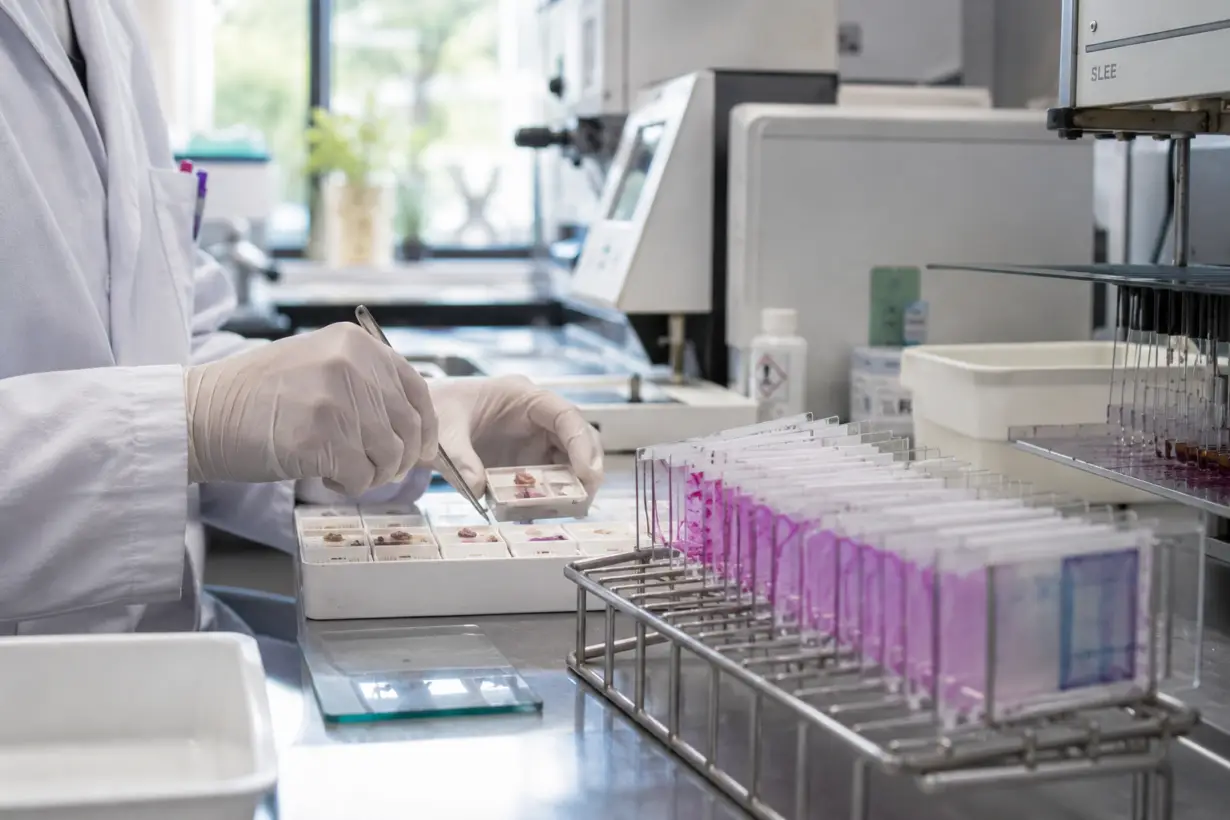
The process starts with the tumour itself. Once removed, it is genetically sequenced to identify the mutations specific to that person’s cancer. Those mutations cause the cancer cells to produce slightly abnormal proteins, which is what makes them visible to the immune system in the first place. A treatment is then manufactured containing mRNA instructions for up to 34 of those abnormal proteins. Injected into the patient, the instructions prompt healthy cells to produce small quantities of the same abnormal proteins, which trains the immune system to recognise and attack anything carrying them. Keytruda, given alongside, releases a brake that tumours use to switch the immune response off.
The announcement says the improvement was statistically significant and clinically meaningful. It does not say how large it was.
The reasoning has been sound for well over a decade. The evidence had not been. An earlier study of the same combination followed fewer than 160 patients, was not blinded, and reported a large benefit that held up over five years. Those results belong to that study. They are not what was announced this week and should not be quoted as though they were.
A delayed return is not the same as a longer life
The trial measured how long patients went without their cancer coming back. That is a reasonable thing to measure after surgery, and it is the basis on which Keytruda itself was approved for these patients. It is not the same as living longer. Whether the combination extends life is still being measured, and the trial continues in order to find out.
Two further cautions apply. This was a planned early look at the results rather than the final analysis, which usually means less time has passed and more uncertainty remains than the final numbers will carry. And a company announcement is a disclosure to investors before it is a contribution to medical evidence. The finding stands. It cannot yet carry the weight that a published dataset and a survival result would give it.
Who will actually be able to get this
Every dose requires a tumour sample, a laboratory able to sequence it, computing capacity to work out which mutations the immune system can recognise, pharmaceutical-grade manufacture of a product intended for exactly one person, refrigerated transport back to the clinic, and nine appointments across roughly a year alongside intravenous infusions.
A treatment like this is assembled once, around a single patient. For the next one, the production line starts again from scratch.
Melanoma affects a particular population, concentrated in fair-skinned groups, with more than 330,000 cases recorded worldwide in 2022. Even within that group, few health systems can run the full sequence described above. Merck and Moderna are now testing the same approach in lung, bladder and kidney cancer, where patient numbers are far larger. If it works there, manufacturing decides the rest. A product built one patient at a time reaches only as many people as there are sequencing laboratories, manufacturing slots and health budgets to pay for it.
The contradiction sitting alongside this
In August 2025, the United States Department of Health and Human Services cancelled 22 federally funded mRNA projects worth close to $500 million and said no new ones would be started. Those cancellations concerned vaccines against respiratory viruses rather than cancer, and the trial announced this week was funded by industry. The manufacturing capacity, the regulatory experience and the trained workforce, however, are shared across both. A country stepping back from a technology in one application will find it slower and more expensive to move in another.
What to watch next
Three things will determine how this result reads a year from now. The actual size of the benefit, once the data are presented. Whether patients live longer, which this trial has not yet measured. And whether the same approach works in cancers that carry fewer mutations than melanoma does, since that is where most patients are.
Until then, the accurate description is narrow and still substantial. A treatment designed around one person’s tumour changed the course of their disease in a large randomised trial. That had not been shown before.